Multispectral & Hyperspectral Imaging
•
January 2024
December 2025
Beyond the Naked Eye: How 'Invisible Light' is Changing Farming
For generations, the image of farming has been one of soil, sweat, and machinery working the land. While that foundation remains, the modern farm is increasingly a high-tech environment where data is as vital as daylight. A quiet revolution is underway, driven not by bigger tractors, but by a powerful new way of seeing. This new way of farming is precision agriculture, powered by multispectral and hyperspectral imaging—technologies that enable farmers to see far beyond the visible spectrum.
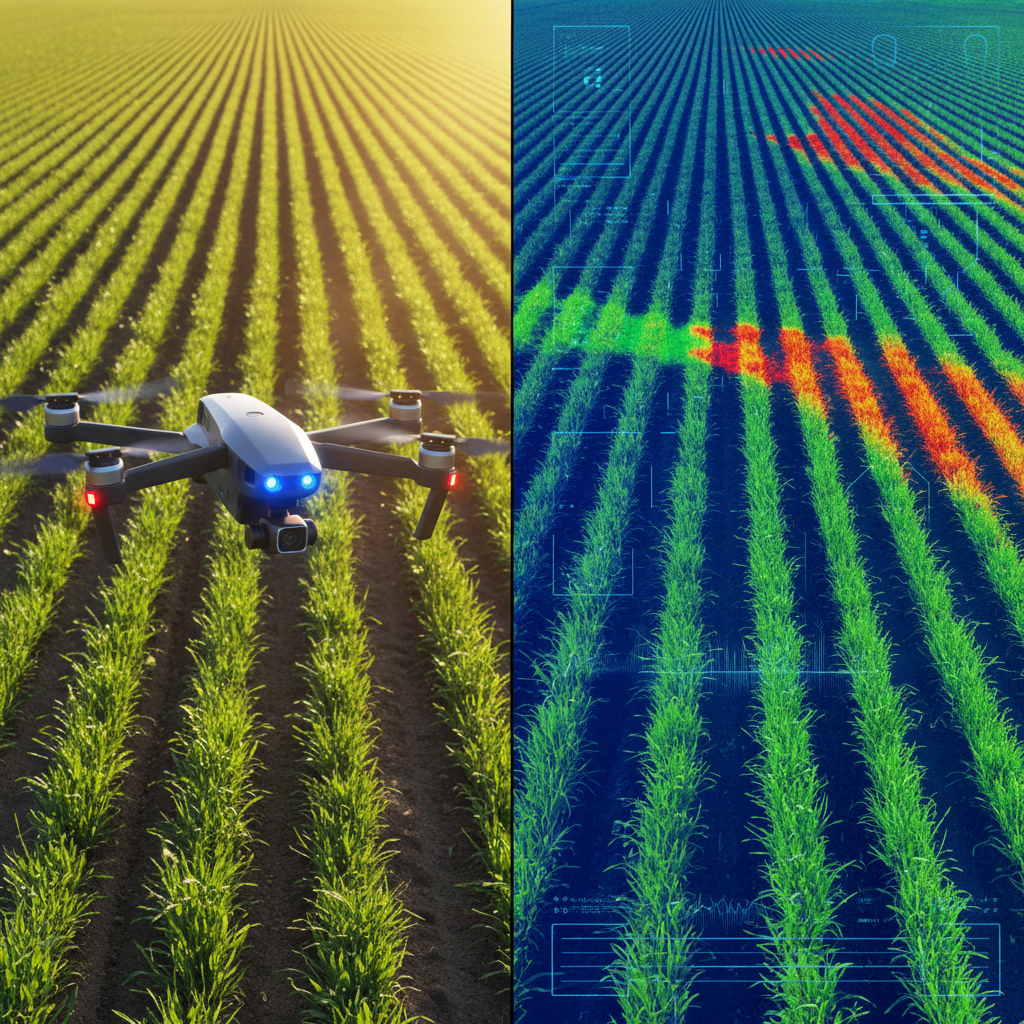
These advanced imaging techniques, often deployed from drones, provide an exceptional view into the health and potential of crops and soil. By capturing and analyzing invisible light waves, farmers can detect subtle signs of stress, nutrient deficiencies, and disease long before they become visible problems. This method isn't just about spotting issues; it's about uncovering a hidden layer of data that is making farming more innovative, more efficient, and fundamentally more sustainable.
It's More Than Just "Sick or Healthy"—It's a Precise Diagnosis
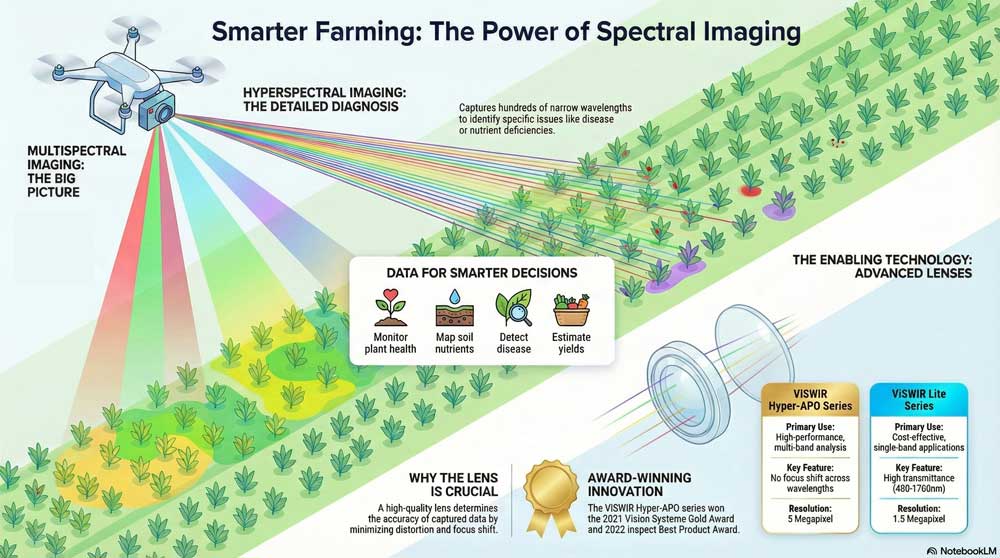
Multispectral and hyperspectral imaging both provide valuable insights, but they function at different levels of detail. Multispectral imaging is like a general check-up for a field. It captures a handful of specific light bands to measure generic characteristics, giving a broad picture of plant health across a large area. It can tell a farmer that a section of the crop is struggling.
Hyperspectral imaging, however, goes a step further, serving as a diagnostic tool. By capturing numerous narrow, continuous bands of light, it can be used to accurately diagnose the specific cause of a plant's condition. These extra bands of light can be associated with specific physiological traits, revealing the chemical composition, size, and shape of the plants. This data allows farmers to move from generic solutions to highly targeted interventions, saving resources and improving outcomes by addressing the specific nutrient deficiency, water stress, or disease present.
The Foundation of Farming: Mapping the Secrets in the Soil
Although analyzing the plant provides a real-time health report, innovative agricultural practices begin before a seed is planted. Advanced imaging technology is just as crucial for what's happening underground as it is for the plants above it. Multispectral imaging can produce detailed maps of key soil properties, providing a foundational dataset for the entire growing season. This analysis can reveal critical information about the land, including:
- Moisture content
- Organic matter content
- Mineral composition
- Soil erosion
By understanding the soil in such detail, farmers can optimize irrigation schedules and improve crop yields from the ground up. This process allows for a surgical approach to farming, applying expensive fertilizers only where needed and conserving water, directly boosting the farm's bottom line and ecological credentials.
Breaking a Major Bottleneck in Plant Science
For decades, agricultural research has faced a significant hurdle known as the "phenotyping bottleneck." Phenotyping—the process of observing a plant's physical traits as an expression of its genes—has traditionally been slow, expensive, and labor-intensive. This challenge has limited the speed at which farmers can develop new, more resilient crop varieties.
Multispectral imaging, especially when deployed by drones (UAVs), is emerging as the key tool to break this bottleneck. It enables researchers to collect and analyze rich spectral data at scale, dramatically accelerating the process. This innovation is yielding a new crop of sensors and imagers that help scientists develop improved varieties of staples like corn, cotton, potatoes, sugar, wheat, and peas much more quickly.
The Unsung Hero: Why the Lens is the Most Critical Component
While drones and cameras often get the spotlight, the lens is the single most critical component for ensuring data quality in any spectral imaging system. The lens determines the amount of light and the specific wavelengths that reach the sensor, directly affecting the accuracy of the captured data.
A high-quality lens performs several crucial roles: it determines the spectral range (which wavelengths are captured), controls image quality by minimizing distortion and aberration, and enables accurate spectral analysis by properly focusing light onto the sensor. A low-quality lens can introduce errors and lead to inaccurate data, rendering the entire system ineffective. Without a high-quality lens, the precise diagnoses in Section 1 become mere guesswork, and the soil maps in Section 2 become unreliable. Superior optics, such as Computar's ViSWIR series, are essential for anyone relying on this technology for reliable, data-driven decisions.
Beyond the Farm: Ensuring Food Safety and Monitoring the Planet
The applications of multispectral and hyperspectral imaging extend far beyond the farm gate, contributing to a safer and more sustainable world. This versatile technology is being used across a range of critical industries and research fields. Other valuable uses include:
- Food Safety: Identifying contaminants or detecting alterations in food products to ensure they are safe for consumption.
- Environmental Monitoring: Mapping land use changes to identify areas of deforestation and urban development.
- Climate Research: Studying the effects of climate change on crops to develop more resilient agricultural systems.
This versatility demonstrates how a single core technology can have a wide-ranging impact, helping to secure the global food supply chain while providing vital data for better environmental stewardship.
A Clearer Vision for the Future
By revealing everything from the nutrient profile of the soil to the genetic expression of a crop, multispectral and hyperspectral imaging are giving farmers, researchers, and environmental scientists an unprecedentedly clear view of the world around us. By making the invisible visible, they are enabling more data-driven decisions that improve efficiency and productivity.
Why does this hold significance in the year 2025? As we navigate the complexities of increasingly unpredictable climates and dwindling resources, the advanced capabilities we develop today are transformed from mere advantages into essential components of contemporary agriculture. These innovations enable farmers to cultivate their land in a more efficient and sustainable manner, ensuring that they can yield healthy crops while minimizing environmental impact. Embracing such advancements has become crucial for fostering resilience in farming practices and securing a sustainable future for generations to come.
The ultimate benefits of this technological shift are profound, promoting more productive, chemical-free, environmentally friendly, resource-efficient, and sustainable farming methods. With continuous innovation, Hyperspectral and multispectral imaging will play an increasingly significant role in shaping the future of agriculture.
Sources:
- https://www.computar.com/blog/multispectral-and-hyperspectral-imagings-impact-on-agriculture
- https://www.sciencedirect.com/science/article/pii/S0168169924004289
- https://farmonaut.com/remote-sensing/hyperspectral-imaging-in-agriculture-market-2025-advances
- https://www.livingoptics.com/top-3-benefits-of-hyperspectral-imaging-for-agriculture-research/