Machine Vision & Robotics
•
September 2023
July 2026
From Detecting to Deciding: How Agentic AI Is Rewiring Machine Vision
For years, machine vision had one job: look at something and flag what's wrong. A camera catches a defect, a sensor spots a misalignment, an alert pops up on a dashboard, and then a human decides what to do about it. That model's starting to crack.
In 2026, the systems showing up on factory floors don't just detect anymore. According to manufacturingtomorrow.com "A new phase of industrial intelligence is emerging through Agentic AI, a technology designed to make decisions, adapt to changing conditions, and complete tasks with minimal human intervention." They decide, recommend, and in some cases act on their own. Here's what's driving that shift, and what's still holding it back.
The shift: agents, not just alerts
The clearest signal came in June 2026, when Sight Machine launched a platform built around AI agents that work directly with plant engineers, not IT teams, to map data, dig into quality drift, and surface fixes in real time. Instead of a dashboard someone glances at once a day, these agents are constantly forming hypotheses about downtime patterns and yield gaps, then handing off validated findings in plain language, inside tools people already use like Teams or Excel.
The bigger idea here is what Sight Machine calls "progressive autonomy." Agents start in recommend-only mode, and as they prove themselves reliable, manufacturers give them more authority over time. Nobody's handing over the keys on day one, but the direction is obvious.
And this isn't a one-off. Broader coverage of smart manufacturing shows the same pattern everywhere: agentic AI paired with vision systems catching quality issues earlier, tracing likely causes, and either flagging a team or auto-adjusting approved parameters before a whole batch gets ruined.
Why this matters
Machine vision hardware is maturing — Interact Analysis projects the core hardware market growing at a modest 6.4% CAGR through 2028, recovering after a rough 2024 (down 3.9%) thanks to inventory overhang and a sluggish manufacturing environment. The real innovation is happening one layer up, in the software and decision-making stack sitting on top of the cameras. That's exactly where agentic AI lives.
The data bottleneck nobody talks about enough
Here's the part that doesn't get enough attention: agentic vision systems are only as good as what they're trained on, and real-world defect data is genuinely hard to come by. Defects are rare. Waiting months to collect enough real examples of some obscure failure mode just isn't realistic when you're trying to scale inspection across dozens of product variants.
That's why synthetic data is becoming a default part of the pipeline. Teams are generating synthetic clean and defective samples, verifying them fast (often in under an hour of human review), and training detection models in a fraction of the time it used to take. One example that stands out: a workflow that used to take months of data collection can now go from five clean sample images to a working, tested model in a single day. Synthetic generation handles the volume; humans just check the quality.
The catch is reliability. Generative synthetic data is powerful, but it needs tight control and human review in the loop, or you risk training a model on subtly wrong visual cues. The real 2026 trend isn't "more synthetic data" it's "more controllable, verifiable synthetic data."
Edge AI makes real-time decisions possible.
Effective agentic decision-making is only successful if it occurs quickly enough to make a difference. A collaborative robot needs to detect a human intrusion in 20-50 milliseconds to trigger a safe stop, and a cloud round-trip (typically 1-2 seconds) just can't hit that window. That's pushed a hard shift toward edge inference: running the AI model right on the hardware at the camera or line controller instead of shipping data to a data center.
Beyond speed, edge deployment also means production imagery never leaves the facility (a real concern if you're worried about proprietary data or compliance), and the line keeps running even if the network drops.
Regional shifts worth watching
A3 and ITR Economics data on AI vision adoption shows North America pulling ahead as the primary growth region (79.9% of industry leaders point there vs. 15.8% for Asia-Pacific), driven largely by reshoring and semiconductor investment concentrated in the U.S. Southwest. Meanwhile, separate analysis from Interact Analysis notes China is emerging as a genuine innovation hub for vision hardware, not just a low-cost manufacturer, putting real pressure on established Western vendors on both price and speed of iteration.
The bottom line
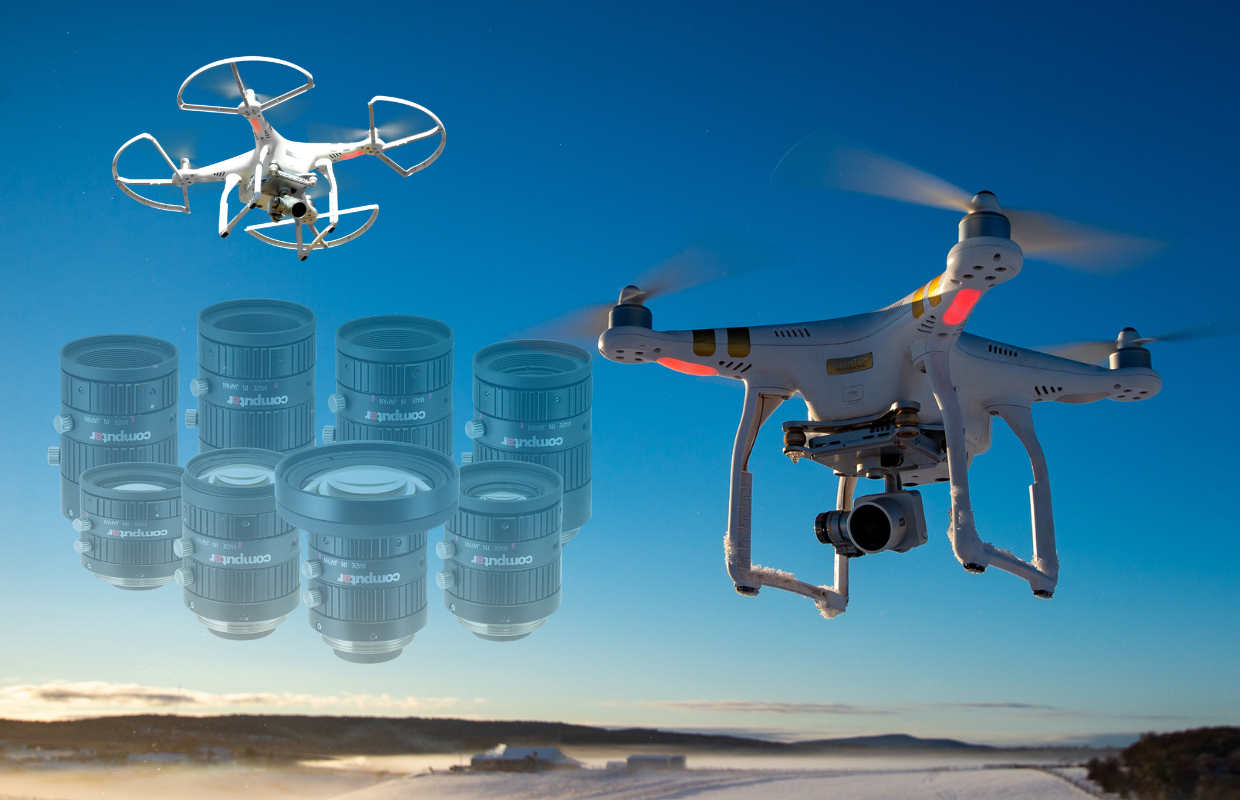
It's easy to get caught up in agents, algorithms, and edge chips and forget where all of this starts: the lens. All decisions an agentic system makes and every dataset it trains on are irrelevant if the incoming image is soft, distorted, or inconsistent. Garbage in, garbage out still applies, maybe more than ever, because now there's an AI agent acting on that data instead of just a person glancing at a screen.
Using a precision lens is essential. Computar's lenses are specifically optimized to capture clean, accurate, and repeatable image data from the start of the process. This ensures that the data is reliable before any AI interacts with it.
As vision systems become more autonomous, the importance of the lens grows significantly. Getting the initial capture right is crucial. Computar lenses enhance the latest and smartest technology. From synthetic data processing to edge inference and decision-making, when we prioritize high-quality input, everything that comes next stands a much better chance of success. Let’s embrace this exciting journey and unlock the full potential of our innovations.
Sources
- Sight Machine — Agentic Manufacturing Platform launch
- Manufacturing Tomorrow — How Agentic AI is Transforming Smart Manufacturing in 2026
- IIoT World — AI Vision Regional Trends 2026
- iFactory AI — How NVIDIA Edge AI Powers Sub-50ms Industrial Vision Processing
- HiTech Digital — Synthetic Data for Computer Vision
- Zetamotion — Beyond Defect Detection: The New Rules of AI Quality Control in2026
- Interact Analysis — Return to Growth Forecast for Machine Vision in 2025 Despite USTariffs
- Vision Systems Design — Machine Vision Forecast: Interact Analysis on AI, Robotics, andGlobal Market Shifts
- Grand View Research — Machine Vision Market Size And Share Report, 2026-2033
- Automate.org —https://www.automate.org/events/advanced-vision-and-ai-conference