
Industry Trends
•
September 2023
September 2026
The Edge AI Evolution: Why Compact Optics Matter More Than Ever
Edge AI is changing how we build smart systems. Instead of shipping massive video feeds to the cloud for processing, modern robotics, automated guided vehicles (AGVs), and smart surveillance systems are doing the heavy lifting right on the device.
While the processing power inside these systems has shrunk dramatically, the optical hardware hasn't always kept pace. Designing lenses that can deliver high-resolution machine vision within a fraction of the traditional footprint is one of the biggest engineering challenges in industrial tech right now.
Here's why compact optics are becoming non-negotiable for edge AI applications, and how modern lens design is adapting to meet demand.
1. The Weight and Space Crunch in Robotics
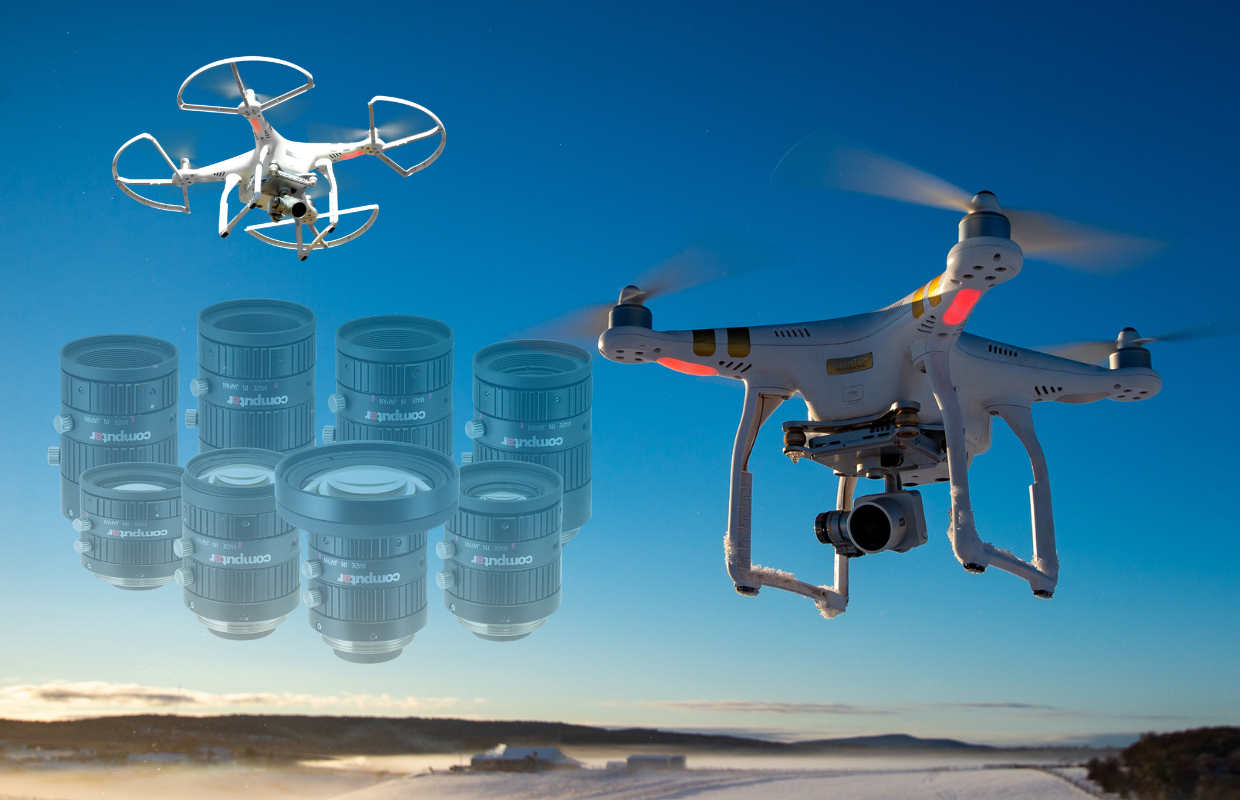
When you're outfitting an autonomous mobile robot (AMR) or a drone, every gram and millimeter counts.
- Payload capacity: Heavier cameras and bulky lenses drain batteries faster and limit the payload a robot can carry.
- Tight mounting spaces: Edge AI cameras often need to be embedded directly into tight chassis corners, robotic arms, or handheld diagnostic tools.
- Center of gravity: Bulky optics perched on top of moving gimbals or robotic joints create torque and instability.
Moving to compact lenses lets engineers integrate multi-camera setups for 360-degree situational awareness without turning the device into a clumsy apparatus.
2. Sensor Evolution: Smaller Pixels, Higher Resolutions
Sensor manufacturers have done an incredible job shrinking pixel sizes while squeezing massive resolutions (4K, 8K, and beyond) into smaller optical formats (like 1/1.8" or 2/3" sensors).
To take advantage of these advanced sensors, lenses need to pack high-density glass elements into much tighter housings. It's not just about making the lens physically shorter; it's about maintaining superior Resolving Power and Contrast Transfer Function (MTF) across a microscopic sensor area.
3. The Thermal and Environmental Challenge
Edge AI devices often operate outside the clean, climate-controlled server room. They're deployed on factory floors, agricultural machinery, and outdoor traffic poles.
When you shrink a lens assembly, tolerances get razor-thin. Thermal expansion can easily throw off focus or distort the image if the mechanical design isn't spot on. Modern compact industrial lenses use specialized glass materials and mechanical housings engineered to resist thermal drift, ensuring that AI inference models don't start failing because the image blurred on a hot afternoon.
4. How Lens Design Is Adapting
To solve these compounding challenges, optical engineers are leaning on a few key innovations:
- Aspherical Lens Elements: Using advanced aspherical surfaces lets designers correct aberrations (like distortion and spherical aberration) with fewer elements, reducing both weight and overall length.
- Advanced Coating Technologies: With smaller barrels, internal reflections and stray light can easily degrade contrast. Specialized anti-reflective coatings help maintain image clarity in compact form factors.
- Optimized Fixed-Focus and M12 Mounts: While C-mount lenses have long been the industrial standard, the shift toward ruggedized M12 and board-level lenses is accelerating as edge AI applications demand ultra-compact footprints.
Finding the Right Fit: Computar Lens Recommendations
If you're building next-gen edge AI hardware or compact robotics, matching the right optics to your sensor footprint is critical. Here are a few lineups designed to tackle size constraints without sacrificing performance:
- Computar MPX Series: Ideal for high-density, ultra-compact designs. These lightweight, ruggedized C-mount lenses are engineered specifically for small-pixel sensors (2µm or less) in a remarkably small footprint. Specs: Up to 16MP | Focal Lengths: 5.5mm (coming soon), 8mm, 12mm, 16mm, 25mm, 35mm, 50mm, and 75mm | Aperture: f/1.8 – f/2.4
- Computar MVS Series: A great option when you need wide-angle coverage and tight close-range performance for autonomous mobile robots or embedded industrial inspection. Specs: High-resolution support | Focal Lengths: 8mm, 12mm, 16mm, 25mm | Aperture: f/1.4 – f/2.8.
- The LensConnect Series: Perfect when you need remote adjustments post-installation. Specs and options: Up to 20MP with focal length options ranging widely (e.g., fixed models: 8mm, 12mm, 16mm, 25mm, 35mm, 50mm, and 75mm; varifocal models: 4mm–10mm, 9mm–50mm, 12–36mm, 16mm–96mm, and 25–50mm, and the new telecentric series available in 0.25×, 0.5×, 1.0×, and 2.0×).
The Bottom Line
Edge AI is only as smart as the data it feeds on. No matter how powerful your neural network or processing chip is, if the lens produces a soft or distorted image at the edge, the AI is left guessing.
As robotics and edge computing continue to scale, compact optics more than a space-saver. They're the foundation of the next generation of smart hardware.
Sources
- Vision Systems Shrink as Intelligence Moves to the Edge: https://www.photonicsonline.com/doc/vision-systems-shrink-as-intelligence-moves-to-the-edge-0001
- Why Vision LLMs Force a Rethink of Edge AI Hardware: https://semiengineering.com/why-vision-llms-force-a-rethink-of-edge-ai-hardware/
- Science Advances article on compact optical system: https://www.science.org/doi/10.1126/sciadv.aea8941
- https://computar.com


